
The Space Between
Written by Honor Bradbeer
30th January 2026
We were six giggling women, carrying bags of souvenirs.
So far, we had been unambiguously tourists. We carried multiple train tickets secreted in pouches. We had clattered our wheeled suitcases into our serene temple accommodation. We had taken turns being photographed with a giant Totoro. We had taken three trains, a cable car and a bus to get here.
We had made all our connections.
But we hadn’t yet connected.
Now we stood outside the Kongobuji Temple in the mountain village of Koyasan, in crisp sunshine.
I don’t remember what, exactly, we were giggling about.
But I know why we were giggling.
We were giggling with the novelty of having no responsibilities, having tearfully farewelled our families back in Australia. We were giggling with mild jet lag. We were giggling with the surprise of sudden new friendships. We were giggling at the incongruity of being in a sacred place with plastic bags swinging from the crooks of our elbows, and feeling inadequate to the monumental structure before us.
I was a little bit daunted.
I felt the pressure to transition from tourist to artist. I didn’t want my sketchbook to hold the drawn equivalent of happy snaps. I wanted this to be meaningful.
Sacred places don’t always work for me.
I can feel unequal to them, and their magic can feel closed to me. Sometimes it is the very anxiety to connect that creates a barrier to connection.
I gazed up at the enormous structure with its thickly thatched roof. I thought, wow! But I felt - what?
Still giggling, we exchanged our outdoor shoes for ill-fitting slip-ons, before shuffling in dutifully reverent silence into narrow timber-floored corridors lined with rice paper screens. On one side, the screens opened onto courtyard gardens, on the other, onto empty rooms.
The rooms were empty because they were barred to visitors. Polite notices asked us to stay out. The walls of the rooms were giant painted sliding screens, adorned with exquisite depictions of cranes and blossoms, glowing dimly with gold leaf. We peered at them, across the threshold, across the bare, untroubled tatami floors. The stillness was commanding.
I tried to feel reverent, but I felt anxious that I wasn’t doing it properly. I didn’t know what I was revering. My knowledge of Shingon Buddhism is minimal. I briefly scanned the brochure in my hand. I scrabbled around in my brain for my knowledge of oriental painting. I had taken weekly classes in Chinese and Japanese ink brush painting for a decade of my childhood, but now my knowledge felt childish: Space is important. Asymmetry is important. The brush is an extension of the body. The whole body paints. Breath is important.
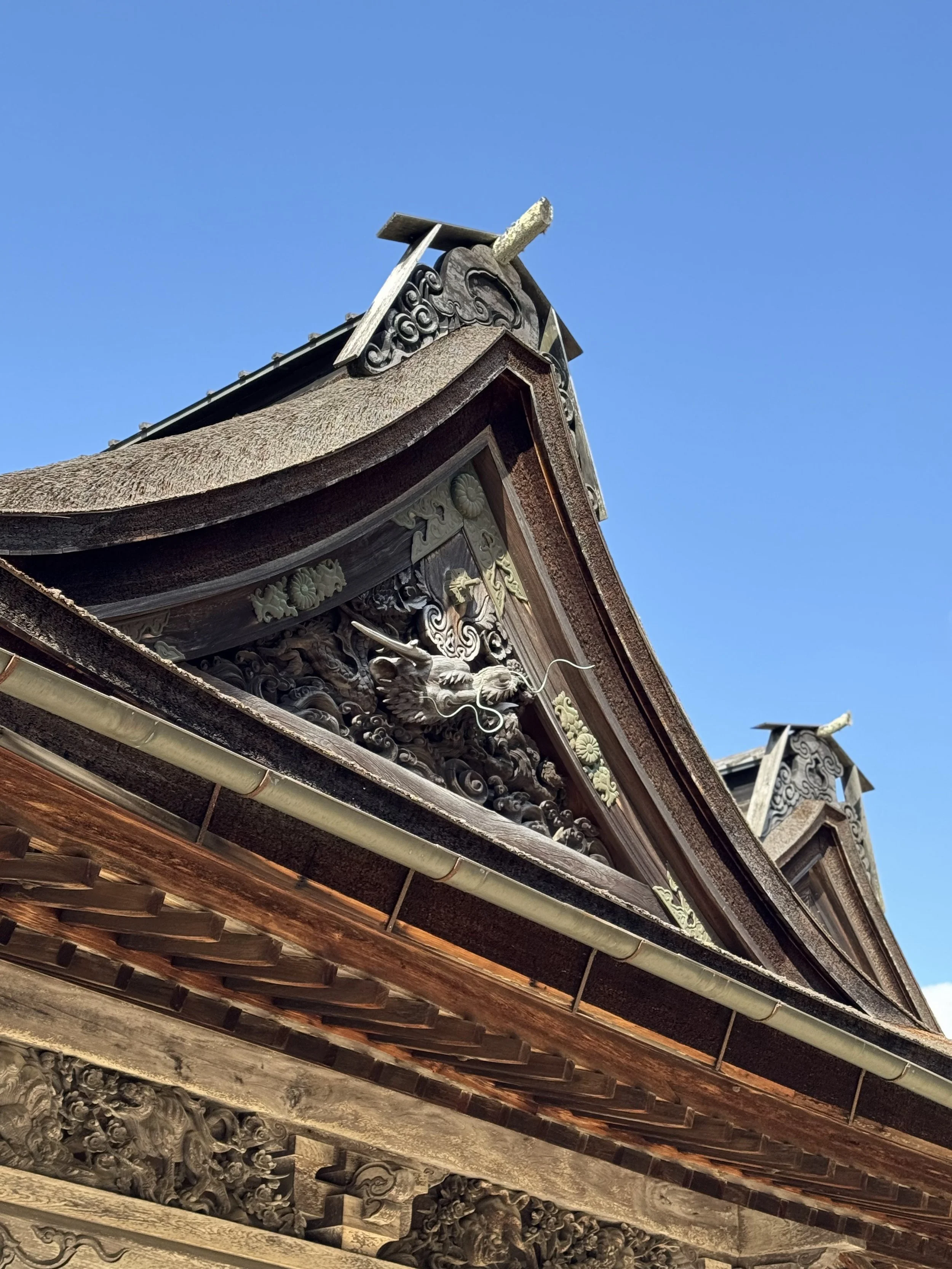
Kongobuji Temple, Koyasan
I breathed, and looked across the room, and observed the spaces in the compositions, and imagined the artist painting the large cranes with his whole body, each brushstroke a visible trace of his unfolding movement in space.
My travel companions gathered silently in the doorway with me, mutely pointing out features of interest. I wondered if they were connecting better than me. I wondered how much knowledge I would need in order to understand. I wondered whether there can be connection without understanding. I wondered if my deodorant was failing me.
We shuffled down the corridor, pausing at room after room, to gaze in appreciation at the different screens, depicting the changing seasons and nature’s beauty in the form of plum blossom, willow, birds and snow.
In the Willow Room, the polite ‘keep out’ notice was accompanied by an arresting piece of information. In this room, in 1595, a man had performed ritual suicide at the command of his uncle, Toyotomi Hideyoshi, the most powerful man in Japan at the time. (The full story of Toyotomi Hidetsugu’s punishment is as appalling as can be, and not for the faint-hearted).
I looked across the tatami-floored space with a different awareness.
How serene it seemed! Here, where such an unfathomable act had taken place.
In this room, despite the mastery of the gilt screens, the empty space was the most active element.
We filed outside, silent, now, of our own volition.
I felt the weight of my lack of understanding differently. I had thought I was looking for something holy here, something to which I was unequal. I had felt ashamed of my bafflement. Now, I recognised the universal bafflement of being human in a bewildering world.
The door we had stepped through took us out onto a balcony skirting the back of the temple, looking out on the Banryu-tei rock garden (the largest in Japan). The orderly stillness matched that of the interior, except for a breeze that made a gleaming spiderweb billow between the fingers of a silver birch.
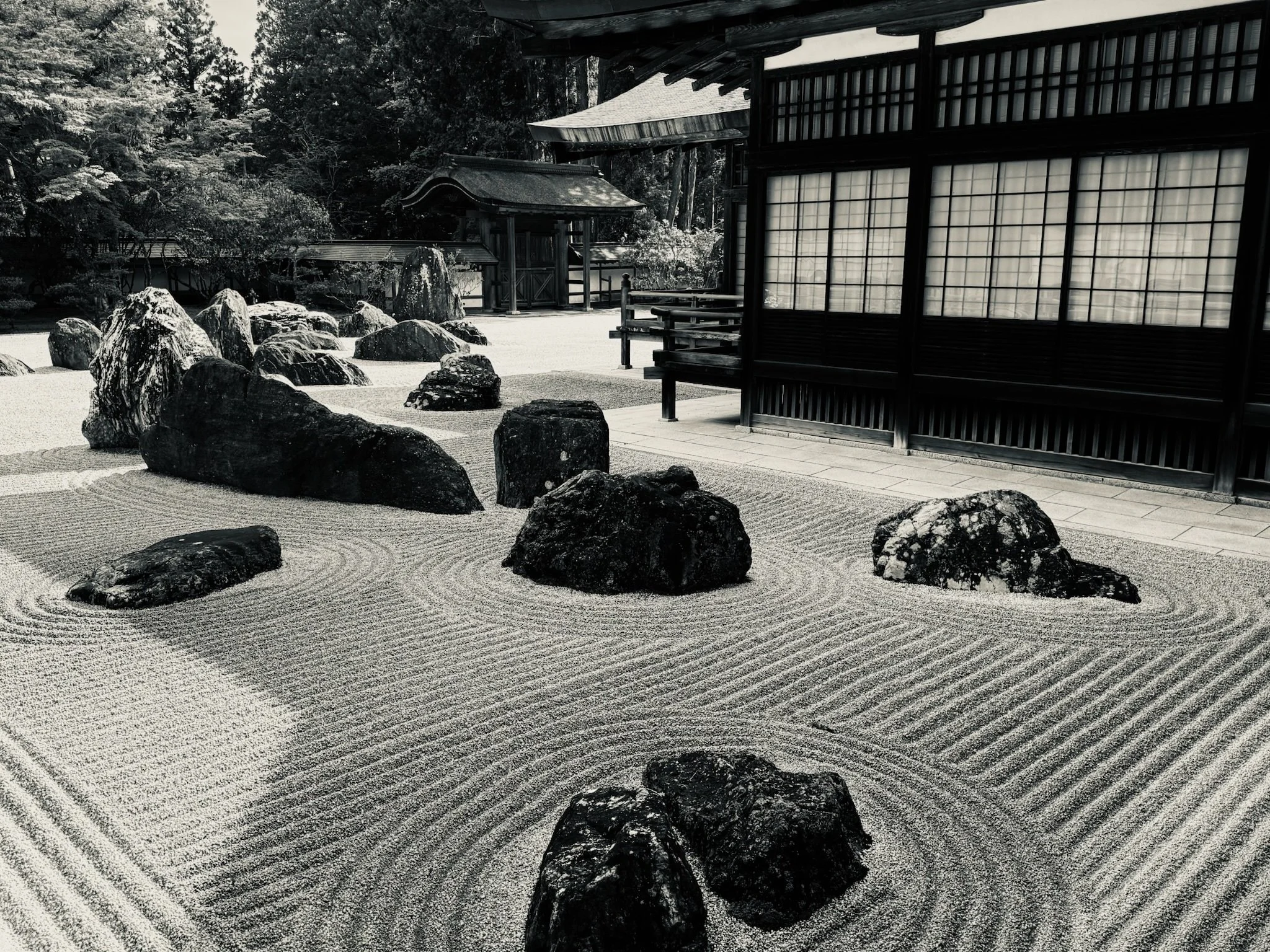
Kongobuji Rock Garden, Koyasan
But here, I felt a point of connection. The large rocks in their motionless sea had a steadying power over my discombobulated soul. They would stand like this in a hurricane, or under snow. I imagined the process that had put them in place, just so. The human brain - capable of atrocities - that had instead chosen to position objects in a quiet arrangement, to enter the gentle, spiritual pursuit of composition. This goes here, and this goes here.
I took out my sketchbook and began to trace the shapes of the rocks lightly on the page, as the sun lengthened the shadows in the empty space between them.